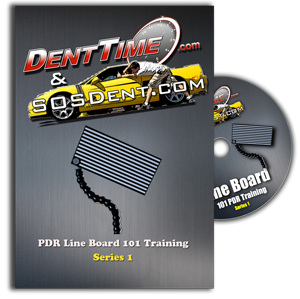
There is a new paintless dent removal /repair dvd video on the market called, Line Board 101 PDR Training. Here is a little insight about it…
Myke Toledo (DentTime.com) and David Pelikan (SOSDent.com) demonstrate the introduction of the line board and paintless dent removal. Two dedicated and successful PDR companies combine their experience to help bring you up to speed with the line board and basic PDR repair.
This DVD was created so you can see the details as if you were there yourself. We know all too well paintless dent repair takes much practice and dedication can be a nightmare without some proper guidance. Whether you are a newbie or veteran who wants to learn more about the line board, you’ll appreciate the detailed explanations and graphic animations that assist your learning curve.
The PDR Line Board 101 Training DVD will help you stay in good habit, while becoming more consistent and perfecting your skills in the art of PDR. The DVD goes for $39.99 and can be purchased at AutoLecture.com
My name is Myke Toledo and I would like to share my body line paintless dent repair I performed on a BMW M3. The dent took over 2 hours to do. If you are looking into pdr training, then you should consider really understand that paintless dent removal is not nearly as easy as it appears.
But back to the subject. A body line dent requires advanced training and understanding how the metal reacts when pushed a certain way with a certain tool. Mainly it is the paint finish you have to worry about. Unlocking the metal helps the paint finish to become more flexible. I used heat in the video as you can see and it helped tremendous. Without using heat, this dent repair would not have been successful. In the early days, a dent like this would not have been even considered for pdr. But today, I have the experience, the latest tools and most of all patience.
No matter how long or your experience, if you don’t understand how to be patient or manage your time, you will rush and not get the best result possible. Anyways, I hope you liked the light pdr dent repair tutorial.
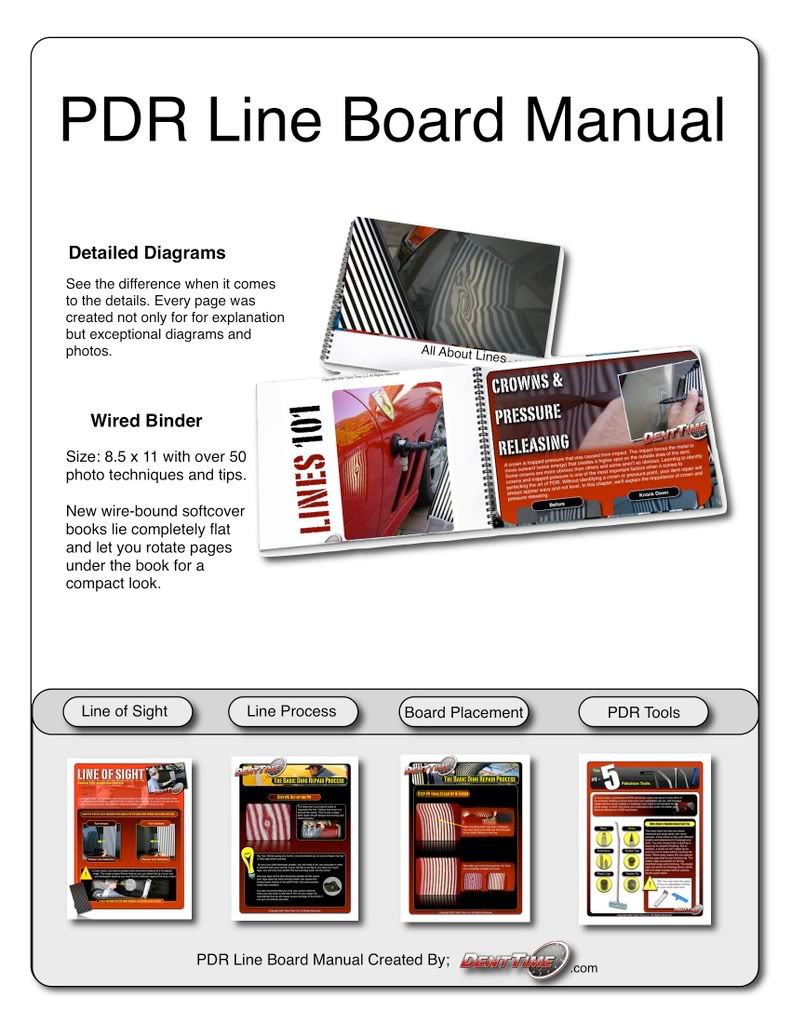
Dent Time blog wrote: Finally after months of photos and tech sessions, we created a manual regarding our line board. This paintless dent repair (PDR) line board was created to help those who either struggle in the PDR industry, newbies, and veteran techs who just simply want to learn more about the reflection.
This manual can also be purchased at PDRCoach.com. (An online store for pdr videos, tips n tricks.)
As the PDR trade gets bigger, the demand for information also gets bigger. From videos, tools and manuals, you’ll find it now on the web. This particular training product is more geared for introduction about how the line reflection is used with paintless dent repair. More chapters will be added for the “advanced pdr tips n tricks” in the near future. These future articles will include, deep creases, extreme big dents, glue pulling and more.
This post was created from Marty Runik (TopGunPDRTraining.com) How can you tell if a Paintless Dent Removal Training School offers poor quality training?
Unfortunately, most of the time there is no way to know you have received poor PDR training until about three months AFTER you train. Sometimes it is possible to tell after the first day of training that a school is poorly run. If the staff looks overwhelmed by too many students or just bored, you may want to leave quickly to get as much of your money back as possible. Here are several things to look for in spotting poor quality schools.
1.Insist on one-on-one training from a qualified trainer. This means eight hours a day, every day with the trainer, working with you alone! Many schools define one-on-one training as spending an hour each day with each student. Other schools may give you eight hours a day with a person that is a poor PDR tech and has little training experience. Before paying any deposit ask for a WRITTEN guarantee, including a FULL REFUND INCLUDING YOUR DEPOSIT, that you will receive CONSTANT one-on-one training with the head trainer only and NOT an assistant. If you arrive at a training school and see that you will not get constant one-on-one training, demand ALL your money back including the deposit before the first day of training is complete. Many schools train at least four or more students at a time per instructor. To learn Paintless Dent Repair properly, quality one on one training is a must. In certain situations a maximum of two trainees can be trained simultaneously, but this situation needs to be carefully evaluated by the trainer before any training is done.
2. Ask if the trainer does any dent work or other activities while training. This is a VERY important issue, because many techs are now supplementing their dent or hail business with what they call “PDR training.” Lets be perfectly clear here. A trainers attention should be focused on the student, not other activities period! Many trainers have the student “observe” them for much of the day while the trainer makes money at his route or retail location. Then the trainer has the student practice exercises for a few hours at a shop. While this is very profitable for the trainer, it is a very poor learning environment for the trainee. Many “trainers” will justify this practice by calling it “real world experience”. This is just not true. A student MUST learn the basics thoroughly first, by constant one-on-one work with the trainer. There are many ways a trainer can give a student real world experience, including some observation of the trainer work. But if this exceeds about 3 or 4 hours TOTAL during 2 weeks of training, beware…you are almost certainly being scammed.
3. Does the training school offer advanced training in addition to beginning training, and are techs going there for advanced training? Many working technicians are always seeking to improve their skills. A quality trainer can and will offer this training in addition to basic training, and should have an excellent reputation for doing both. A school that only offers beginning training may do so because no experienced working technician would ever consider that school to advance their skill level. If the school offers advanced training, ask for a referral list of working techs that have gone through their advanced training program and call them.
4. Does the school make their own tools, or have them made by one company? Most all experienced techs will tell you there is no tool company that makes every type of PDR tool well. If you want a true quality set of tools, you should choose from the five or six tool manufacturers that make quality tools. You should ONLY choose your tools from these quality manufacturers during your training, not before. A good trainer will always guide you in the proper selection of your tool set, and will teach you how to recognize the MANY differences between a good quality and poor quality PDR tool. ALWAYS ask to see and keep a copy of the ORIGINAL manufacturers tool invoices at any Paintless Dent Removal Training school that sells tools at the school. Many schools make the tools themselves, or have their tools made in China or Taiwan with a HUGE mark up to the student. .
5. Beware of any Paintless Dent Repair school that tells you learning PDR is easy. This is simply not true. PDR is an art that requires a lot of drive, patience, and proper training to learn. Most standard ways of teaching this art require about a six month learning curve of very diligent practice before starting to repair real world dents. The methods used by TopGun can cut the length of this curve by about half, but the same diligent practice is still needed.
6. Question any company that tells you they can train you from the start in one week to do real world Dents. There is no way this can be done. A bare minimum of 2 weeks of very intensive over-the-shoulder training is needed. Three weeks is ideal when it can be done.
7. You contact a Paintless Dent Repair training school and are barraged by phone calls shortly afterwards. This indicate the school is far more interested in selling you training, than actually training you. Another warning sign may be a salesperson that keeps lowering prices with each follow up contact they make with you, until you agree to train with them. Many of these schools employ trainers that can’t make a living at PDR for one reason or another, and are not gifted teachers. A school that seems to do anything to make the sale should be avoided at all cost..
8. Ask for references from WORKING techs who have attended the school. Some companies employ people who will give them a glowing referral, but have never attended the school, and can’t fix a dent. Beware of testimonials that list names and states only after them. Anyone can make up a testimonial and put it on a website. Testimonials should have the cities and names of businesses after them so they can be verified and checked out.
9. Visit Paintless Dent Repair forums where techs from all over the world gather to discuss PDR related issues. Do searches on these forums about the training school you are interested in and see what techs are saying about them. Probably the best forum for this purpose is at www.doording.com
10. Before signing any contract, ask to speak to the person who will be training you. Get any questions answered directly. If you can not communicate well with the trainer by phone, or your questions are not answered well, chances are you will have the same experience while training.
11. Beware of individual trainers that contact or solicit you. Some people train because they can not find work as PDR techs, especially during a slow hail season. These techs will sometimes hold “fire sales” on training to get people to train with them. This training is almost always inferior, and the student usually doesn’t realize it until months after the training is over.
Well, for those who keep up with my blog, here’s a little something different. I created this video because I get many people who ask me about my techniques, the line board and the PDR process itself. My Paintless Dent Repair/Removal video was created to inform and educate all types of people. From potential customers, trainees, veteran PDR techs and just about anyone interested about the PDR process.
Now please keep in mind, this is a real basic explanation so don’t be too critical. I left a lot out and some things on purpose. I do have to mention, PDR is not easy as I may make it appear to be. Pinpointing a sharp tool without missing is extremely difficult. That alone takes hours and hours of practice. And for some it may take months to develop accurate hand-eye coordination.
The line board I use is a high gloss black plastic with 1/4″ white lines spaced apart the same demention. The black and white line as you can tell in the video reflect very well. I have tested all kinds of colors and backgrounds but nothing (In My Opinion) generates a consistent and more readable contrast than black n white. In other words, it works for me.
What I didn’t mention in the video is that the Bentley had some serious thick backing laminated behind the panel. Basically, sound density material to keep the vehicle more quite on the road. I had to use a very sharp tool and I mean pick sharp. There was no other way or I would not be able to pinpoint. Oh and yes, I pulled the panel. That is another video that will be coming soon.
Finishing the last 5%-10% is always the hardest. This is what separates the men from the boys. Unfortunately for the retail market, it can be hard for them to distinguish a decent repair from a great repair. And this is one reason behind my video. But back to the subject. If you notice when you are trying to finish the last part, the center becomes hard to pinpoint. Ever wonder why? Well it could be numerous things like; not being patient, using the wrong tool, incorrectly reading your board, your not eye-level and probably the most obvious, your experience. Hang in there though. You’ll get it or maybe not? That’s up to you! If you find yourself still struggling, then you might consider Advanced PDR Training. This will definitely speed up your learning curve.
For those who are just interested in the service, I can assure you that my Company Dent Time will perform a thorough and high quality repair on your vehicle at an affordable cost.
When I saw this dent and I knew I had to at least take some photos and document my PDR process. I never get tired of taking photos of my work. Besides, it’s really not work. To me it’s having fun doing what I love. Paintless Dent Removal has become my passion behind marketing my passion. I also train PDR personally as well. From beginner to advanced, I share my passion and devotion to paintless dent removal and the auto reconditioning market.
Now enough about that. Let’s briefly talk about this dent repair. It is quite intimidating indeed for any experienced tech. Although if you are an experienced tech, that feeling only last briefly until you begin to perform the job. Tools were essential. Wrong tools, wrong results. Although it takes more than tools to gain good results. A little patience, correctly reading the board and of coarse… experience.
I used a bladed shaved door tool (Ultra Dent Tools) to do most of the dirty work. I also used a knock down from (Dent Craft Tools) or (Dent Gear) to remove the crowns and highs. Now I can’t just rush into the center. If I do, I will cause an oil can effect and then it will be a done deal, game over. I work from the top, then tap. I use this technique back n forth and switching sides in between so I keep the dent balanced.
Little by little within two hours, I have completed the job. No sanding, painting. Just one happy customer and a little satisfaction.
If you have questions about my PDR repair, please feel free to comment. You can also visit my official web site at DentTime.com
Here we have a fairly deep dent on the body line of a 750IL BMW. As you can see when you blow up the photo by clicking on the diagram, you’ll notice the pinched lines above the center of the dent in photo #1. If you don’t release pressure off the crown, you are going to have a real hard time moving the dent.
The #2 photo you’ll notice the lines above the center dent are now straighter. Which indicates pressure has been removed. From here, we’ll work gradually push from top to bottom into the center.
As the we work the dent towards the center, the outside surrounding area will become tighter (Photo #3). We want to knock down the outside to help relieve pressure. This helps the flexibility in the paint so we don’t cause cracking. Now it’s important you are very accurate pushing. A good idea would be to use some type of protection on the tip of your tool like tape or a plastic cover.
#4 photos shows a slight high and a low. You want to keep your dent always clean as possible before you work the center. (Some cases, you can work the center direct but in this case, the dent is too deep for this method) Make sure you switch sides between pushing and knocking down so you can keep your dent balanced and clean.
#5 This photo shows that we are close after repeating steps 3 & 4. Again we are always checking from one side to the other.
#6 The final step. Cross checking is important. Stand up and move your board in all directions to catch any curvature or fade that will indicate your repair. Clean and polish.
Now this is a real basic explanation of our PDR repair. With one on one training, you’ll have a much better understanding and grasp of this technique. For inquiries of PDR Training, please visit the main website. Or visit their official blog by clicking here.
Crowns and pressure releasing is one of the most important factors to understand and learn about paintless dent repair. It is also the most overlooked lesson during a trainee’s learning experience. Mainly due to not enough time during PDR training.
We show an introduction page from our Basic Line Board Manual regarding crowns. Not a whole lot to show but enough that you can tell what a crown looks like through our eyes and the line reflection. Our PDR training goes into depth about “identification.” If you can’t see it, how are you going to remove a dent completely?
In most cases, PDR techs who are not aware of crowns or simply don’t see them, end up forcing a dent to come out. Unfortunately, that won’t work. Instead the results are either a wave still visible or unwanted push marks. Identifying crowns and releasing pressure creates a smoother and faster repair which eliminates forcing a repair.
You must understand a dent wants to go back to its original shape. You just need to know why, how and where. Moving the board in different angles is one key but the details that are surrounding it is what puts it all together.
Our one-on-one PDR training explains in detail why you are missing what you’re not seeing. If you are already a veteran PDR tech, you may want to purchase the Basic Line Board Manual before taking advanced training? Although again, there is no substitution for personal and one-on-one PDR training.
Our pdr manual is designed to give you more insight which can make all of a world of difference. If you have any questions regarding PDR training or the Line Board Manual, please visit denttime.com
Learning About Reflections - Paintless Dent Repair/Removal PDR
This article was written by Vince from Dents No More in Orange County, California. He’s a PDR tech who has been performing professional PDR since 1994. A “fog” reflection specialist who explains the use of his reflection.
Written By Vince from DentsNoMore.com
FOG 101
When using a fog board to repair a dent, using the paintless dent removal technique, board placement and lighting are critical. The whole purpose of using a fog board (reflection board) is to see the damage better. The board itself is usually yellow or white. The line is painted on with a flat black can of spray paint. One single line down the middle with the over spray acting as the fog. The over spray is crucial mainly because that is the fog! Not too much and not too little. The purpose of the fog is to see depth of the dent and to highlight the natural orange peel of the panel. It also helps you see the tip of your tool better, which allows better-controlled pushes. When outside, most people that use fog boards will try to have the sun behind them to light up the fog board. When inside lighted fog boards come in handy.
With a single line reflection board there are two pictures you can see inside the dent. Think: Negative and positive.
What happens is if you use the side closest to the skin of the car the dent is shaded down the middle on one side of the dent. If you shift your head and look at the reflection of the dent on the topside of the board the opposite side of the dent will be shaded. The whole purpose of this is to find the middle of the dent. Where the black and yellow meet is where the center of the dent is. Now you can start pushing. For years many skilled body men use to start on the outside of the dent and shrink the metal in towards the middle. This is not true with PDR. With our theory, by making precise pushes in the center circling out, the metal regains its strength. Layer by layer, push by push. In a crease type dent a zipper technique is used. Starting at one end and zig zagging through the dent. Once again, layer by layer. It is crucial to remember each push made effects the previous and the next push. As the dent is being removed layer by layer, the board must be moved farther and farther away. When starting out the board will be about one foot away from the dent. When finishing the dent, the board can be as much at four feet away from the dent.
Wrote by: Myke Toledo - Dent Time San Diego - Paintless Dent Repair/Removal PDR Training
Being a well rounded paintless dent repair / removal PDR tech means you can adapt. From deep door dings to large and stretched dents, you should be able to handle about 90% of the dents come your way or more important, you take on.
Performing large and complex dent repairs do pay off. Some PDR techs think there is no money doing these type of repairs. We would like to disagree. If your time is valuable and you do above average work, you can very well indeed make a great living doing these type of PDR repairs. Come to think of it, most people are not as concerned with small door dings as they are with big dents like in the diagram.
Advanced PDR training is a good option to consider if you plan to be doing PDR for a awhile. Even in some cases a dent is not going to come out 100%, you can still make a customer very satisfied based on what you had to work with in the first place. Before we begin a repair, Dents like these we are always clear to the customer they will most likely notice a slight wave or indentation near the body line. It is almost certain with clear and upfront communication, your customer will be happy.
Although there was much more involved with this dent repair than what was shown in the diagram.This diagrams gives a sneak peak of the basic PDR Line Board Manual that is now out on sale at AutoLecture.com.